Is NYC Tennis History in Jeopardy?
Watching the television show Jeopardy recently, I wondered why my mind is crammed with seemingly useless information? And, worse, why am I proud of it?
As the calendar turns into another year, it seems that more of the oral history of tennis in our city will disappear. I am a thorough researcher, but calling friends and using Internet search engines have proven disappointingly unsuccessful when tracking down tennis facts that interest me.
I discovered that the Works Progress Administration built many New York City public parks during the late 1930s. But finding information about the tennis courts built in those parks was elusive—I found none. Refugees fleeing the havoc visited on Europe by the World War II found homes on these New York courts. And they brought with them the cultivated traditions they learned in many small tennis clubs scattered on the continent. Everyone wore all white, they brought picnic baskets with them, and many of them spent the day. I found a welcoming home among these émigrés who created unofficial clubs on courts built by unemployed Americans during the Great Depression.
Barry MacKay died this year. I had a chance to speak briefly with him at the U.S. Open a few years back. This long-tenured broadcaster was very honest when he told me that the question most people ask when they first meet him is, “How did you get into tennis, did you ever play?” Can we try to remember that in 1959 he defeated Rod Laver in a Davis Cup match played at the West Side Tennis Club in Forest Hills, N.Y.?
Jeopardy question one: Which Italian tennis star would repair the strings on his racket on crossovers during a match? Stories are told that he would even begin to completely restring a racket at his beloved 45 pounds of tension. Who is Beppe Merlo? He played off both sides with a two-handed grip, and was best described by Rod Laver as a “real weirdie.” Rackets were strung by hand back then, and stringers would pluck the strings like musical instruments to determine the tension.
Jeopardy question two: What was the price of a can of tennis balls in 1960? What is $3-$4 for a can of three? Plus, you had a drinking container as a bonus—just fill the tin can with water from the public fountain. No worries about plastics seeping into your drink.
Pancho Gonzalez was an insightful television commentator, but sometimes he missed big. I heard him criticizing Jimmy Connors on the air for putting the spare ball in his pocket during a match (Connors was one of the first two-handed players). Gonzalez’s projection was that Connors was headed for major hip problems in the future. What would Pancho have thought about all the women tucking the spare ball under their panties?
Jeopardy question three: In 1960, how many balls did you hold in your tossing hand while serving? What is two? You always held two balls in your hand for the first serve, and if you missed, you were ready for the second serve without delay. You then held the ball in your non-dominant hand throughout the point.
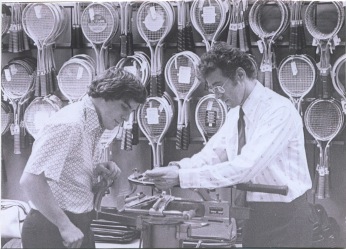
I managed a tennis shop during the early 1970s, a period that saw the weight of wood rackets drop significantly. I remember the thrill of finding a few 12 ¼ ounce Dunlop Maxply Forts in my deliveries. But those light frames came at a price—increased breakage, especially at the shoulders.
One evening, a Snauert representative with time to kill stopped by and educated me on how the desire for lighter frames was forcing manufacturers to change. He explained that wood from the top, middle and bottom of a mountain was used in different parts of a racket, and that the newer weights used wood with less water. Manufacturers had to change their traditional techniques. As a trivia aside, I asked him how the very light and poor quality rackets being shipped from Pakistan could be labeled as “Made in England?”
He told me that only the grip had to be wrapped in England in order to qualify for the label.
Of course the times were quickly changing and racket technology and names were now heralding a new age. “Autograph” and “Player’s Special” models were being replaced with numerical designations like the Tony Trabert C-6 and the Jimmy Connors T-2000. Aluminum, steel and graphite were the desired materials.
I admit to another research failure … years back, winter tennis in New York was mostly a frigid exercise in devotion to the game, and only offered rare opportunities to play indoors. One year, I played in a National Guard Armory in Washington Heights, a community in uptown Manhattan. The courts were set up on a highly-polished drill floor, surrounded by two-and-a-half-ton Army trucks with their hoods open. If you were opposing a superior player, as I often did, the ball skidded at you rather than bounced. And when you missed, you sometimes had to climb up on a truck to retrieve your ball from inside the motor. After many telephone calls and Internet searches, I have to conclude that memories of this very unique moment in NYC tennis history are gone.
One last thought about how the game and the players have changed. When the U.S. Open was played at Forest Hills during the early 1970s, it was common to see the top players get off the subway they had taken from their hotels in Manhattan, and stop at McDonald’s for takeout. If you follow the game today, you know how strange that seems.
Are these the tired reminiscences of a guy nursing a drink in the corner of the clubhouse bar? Or are they part of the powerful oral history of tennis in New York City?
Should we lobby Jeopardy to establish a “History of Tennis” category? In that case, Mr. Trebek … GAME ON!