New York Tennis Magazine’s Literary Corner: Grandpa McEnroe … Seriously?
Many of us read biographies about celebrities to learn the whys and wherefores of their success. Sometimes we just want to get the dirt on them so we can feel judgmentally superior. A bonus for careful readers is the chance to glean better insight into themselves.
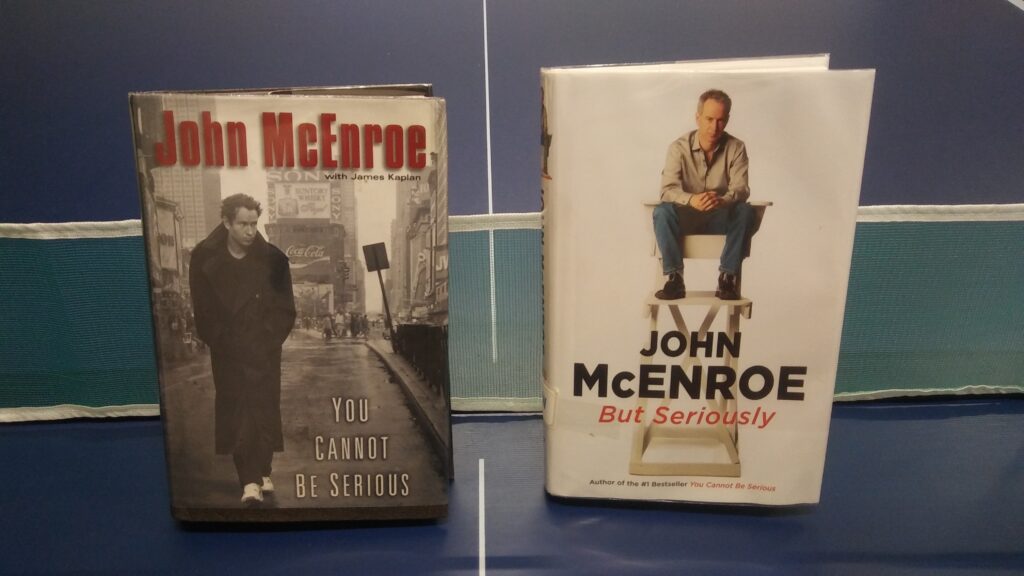
Compare the cover photos of John McEnroe’s latest book, But Seriously, with his 2002 book, You Cannot Be Serious. Back then, he seemed to model himself after Bob Dylan with the long black coat, upturned collar and distancing stare. I found the tone of the earlier book to be defensive and self-justifying. And I was, at the time, more swayed by my own resentful envy. After all, I grew up less than a mile from McEnroe, so why wasn’t I on TV?
On the cover of his new book, his posture is open and exposed, and he stares right at you, as if the physical image mirrors his personality. He wants to communicate. Which I think is exactly to point of this book.
In the opening pages of But Seriously, he addresses a subject that he calls a “dark moment in his career,” his loss to Ivan Lendl in the finals of the 1984 French Open. He half-heartedly tries to weasel out by writing that a friend left halfway through the match, apparently violating an unwritten rule that friends and family do not leave before a match is finished. Then, he ranted at one of those perennially irksome cameramen whose headphones were set to a distractingly loud volume. But after five long sets, Lendl was the winner and McEnroe admits, “I lost my grip on the match. I tried and tried, but in the end, I was the one walking to the net with my head down.”
This not a “how-to-play tennis” book. The only two paragraphs of this nature I found while reading But Seriously suggest tactics that most of us would find difficult to apply. McEnroe states, “Sometimes I would try to wear the other guy down mentally and physically by extending a point on purpose. I’d try to get it to a 20-shot rally so that he’d be expending some energy, then he’d be breathing hard on the next point.” Pages later, he writes that, “I’ve never been a big hitter, but relied on quick hands, good movement and a smart tennis brain to overcome opponents—my style was to try and help the guy on the other side of net to beat himself.”
Incendiary responses followed his comments during the 2017 broadcast of the Wimbledon Championships about Serena Williams’ chances against himself or even the number 900 male player. In the book, he writes, “The subject of me playing Serena has never gone away. Do I think I could beat her? Don’t tell anybody, but I may still be able to do it. Okay, so my daughters no longer think I can. ‘Are you crazy, Dad?’ Being one of their more supportive responses.
Back in 2002, Donald Trump put $1 million on the table for a winner-takes-all match between John and Serena. No one took him up on the offer.
I caught McEnroe referring to himself as a “Silver Fox” a few times. The topic of aging does come up frequently in this book. That he seems to be comfortable with the process he attributes to the love he shares with his wife and children. He also works out three times a week and frequently competes against young athletes at his tennis academy, the John McEnroe Tennis Academy at Randall’s Island. The book is brightened by a chapter written by his wife, and includes an essay and a poem by his daughters. When grandchildren arrive, I can see him putting their first artistic efforts on the refrigerator with magnets.
Because of his outbursts over the years, his image went from brat to super brat, and that image still shadows him. He sometimes wonders, “Is this ever going to stop? Am I going to be a caricature of myself for life.” Despite the mellowing that comes with age, I think McEnroe still wears that Nike shirt with the invisible logo that says “CAUTION.” He is like that discomfiting distant uncle. You might love him, but for your own safety, you do not want to get too close.
Remember that normal does not get you to number one.