At The Net w/ Cinto Casanova, Centercourt Tennis Academy

Tennis is a fascinating sport, in that its impact stretches far beyond the white lines on the court. The fuzzy yellow ball has the power to change the lives of men and women, and take them places they may never have dreamed of.
This is true for Cinto Casanova, the Director of Coaching and Junior Development Pathway for the Centercourt Tennis Academy in New Jersey. Casanova joined the Centercourt team at the end of 2022 after a tennis journey that began in Europe, took him to Asia, and eventually landed him here in North America.
“One of the main things I’ve learned as a coach is to be always evolving, and developing yourself as a coach,” said Casanova. “It’s important to learn new things and never stagnate. This is what excites me and motivates me to keep searching for new ways to help our players.”
That motivation has influenced Casanova to teach tennis in multiple continents over the course of his tennis career, and why the team at Centercourt were so eager to bring him into the fold three years ago.
Casanova grew up in a small town in Spain where the nearest tennis club was more than 30 minutes away so tennis was not his initial entryway into sports. Like most kids from Spain, soccer was a big part of his life when he was young, as was Trialsin, a sport similar to mountain biking.
As he grew older and became a teenager, he decided he wanted to take up tennis. His parents were unable to drive him to the tennis club , but thanks to his experience riding a bicycle, he was able to find his own transportation.
“I was around 13-years-old at the time, so I was quite old (compared to the normal starting age) when I began playing tennis,” he recalls.
Although he trained competitively, he could tell that playing tennis at the next level was not going to be his future, but he always loved sport science and decided to study that when he enrolled at the University of Barcelona.
“I knew competitive tennis was not going to be my path, but coaching tennis would be,” Casanova said. “I knew even before I got to University that I would be a tennis coach. I studied sports science with a focus on tennis. All my work was about tennis, all the projects I did in school were centered around tennis. On my 20th birthday I became a certified tennis coach.”
Soon after, he made the bold decision to move to China, a transition that would elevate him to the next stage of his coaching career, and truly change the course of his life.
“For me, at that time, China represented this land of opportunity,” he explains. “The Western world and Europe in particular were going through an economic crisis. And specifically to tennis, things felt stagnant in Spain, there were not a lot of opportunities to grow or start your own business, whereas China was a playground to build something from scratch; the way I wanted to. It was a developing country that was becoming an economic power. That was the number one reason I did it, and it turned out to be an amazing decision.”
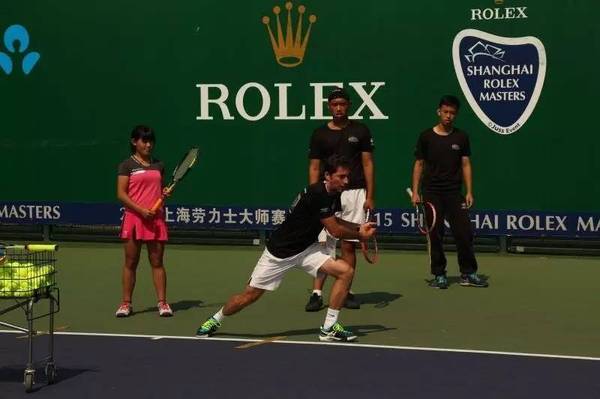
Casanova put in the work, and became the Director of Pro Players Programs at the China Elite Tennis Academy (CETA), which was the official Academy of the Shanghai Rolex Masters in China for nearly two decades. It was also there in China that he met Conrad Singh, someone who would become his mentor.
Singh and his wife Paola opened the first Foreign Sports Academy in China and were its outright owners. Their academy and Casanova’s CETA worked hand-in-hand to develop and mold the pathway for Chinese players, including Li Nah, Shuai Zhang, and many others through their clubs and programs.
“We were both very like-minded, striving for excellence and putting 100 percent into what we do,” said Casanova. “We immediately connected, and we combined our two companies to create the biggest tennis coaching company in Shanghai at that time.”
The two continued to work together for several years, and after a decade in China, as he was always looking to challenge himself and strive for more, Casanova moved to Japan and began working at a traditional tennis club there.
“I enjoyed learning different ways of doing things, and immersing myself into new cultures. Moving to Asia, and moving from China to Japan, offered me a new perspective which allowed me to improve as a coach, and thus improve the way I taught my students,” said Casanova.. “I think that helped me a lot, and made me learn a lot more about tennis, but also myself.”
While he and Singh no longer lived in the same country, they continued to communicate and worked alongside one another on a project for the Australian Professional Tennis Coaches Association (ATPCA). They would see each other at conferences and seminars and continued to discuss future opportunities to further grow their careers.
After Singh moved to New Jersey to become the CEO of Centercourt Club & Sports, he would constantly tell Casanova that he needed to move to the United States and join Centercourt. He would be an asset to the team at Centercourt, and it would provide Casanova with another amazing opportunity.
Having spent 17 years in Asia, 10 in China and seven in Japan, where he also met his wife, Casanova was ready for the next challenge.
“He was always in my ear, and after all that time, I thought maybe it was time,” he says. “America is on the other side of the world, a part of the world I hadn’t seen yet, and I thought that this would be a great way to experience how things are done there; what it could do for my development, and also what I could bring to Centercourt. It was a project that really excited me.”
Centercourt prides itself on being the “toughest playground in the Northeast”, and is always looking towards innovating and expanding its offerings to players, which lined up perfectly with Casanova’s coaching philosophy.
He was integral in helping launch the Red Ball Performance Center at its Chatham location back in 2023 to create a dedicated location for the first step in their pathway. Casanova oversees the development of the academy’s coaches as well, ensuring that everyone they bring in only coaches that meet their standard.
“We have a pathway for all stages, from Red Ball through high-performance ITF level players,” he explains. “But that’s not what makes our academy successful, I think it’s because we take pride and care for our players, at an individual level. We have coaches that care for what they do, and when I select coaches, we make sure that they care. We don’t want coaches who come in, clock in and out and leave. We want coaches that are committed, which means that you need to be committed to tennis 24/7. We find it’s the only way to develop kids and instill the values they need to succeed. And that’s why we have such a good system here, and why our coaches are so loved by our players.”

Tennis has taken Casanova from Spain to China to Japan and now to the United States, and the players and families who have the privilege of knowing him at Centercourt are better for it. His cutting-edge, high-intensity footwork method has made him a recognized world leader for coordination development and skill acquisition.
“I truly have never seen anyone better,” Singh says of his protege.
The connection he and Singh formed in Asia is paying dividends in New Jersey and the greater Northeast, and Casanova is excited for the opportunity to continue, learning, improving, and strengthening the sport of tennis.