Lighting The Future of Tennis
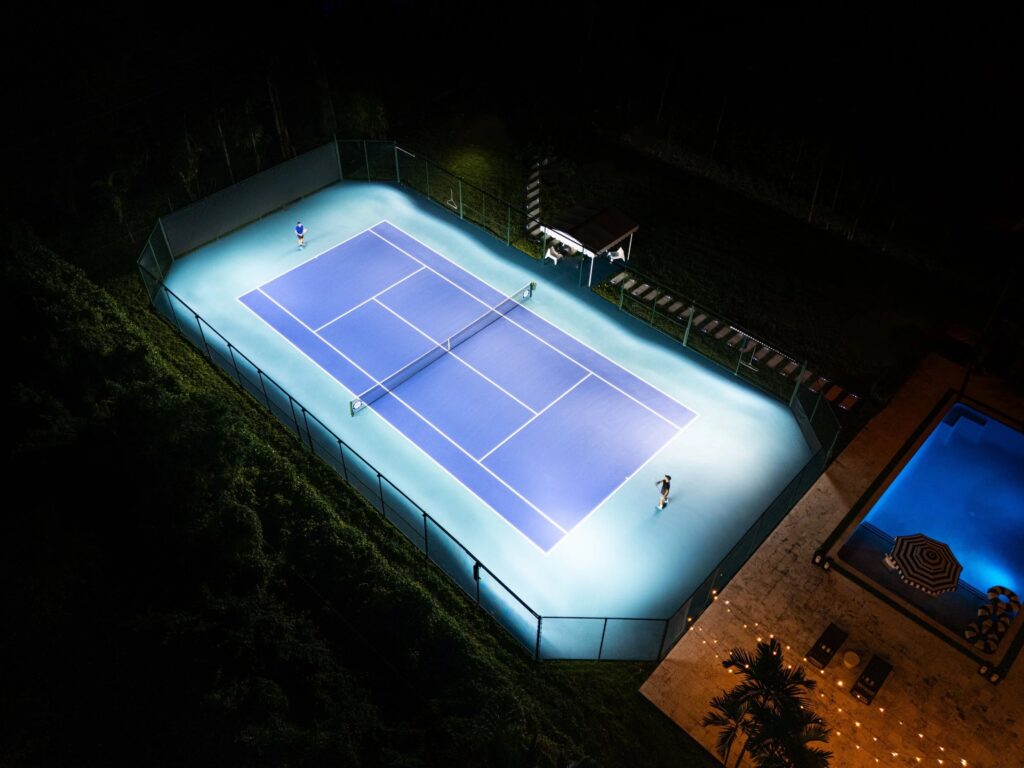
For decades, extending play after dark has often meant expensive lighting systems, towering poles and complicated installations. These are solutions that work well for major facilities but aren’t always practical for neighborhood parks, private residences or smaller tennis clubs.
One company helping to solve that problem is 10-S Tennis Supply, the exclusive U.S. distributor of Tweener lighting, a French-designed system created specifically for racquet sports. Unlike conventional fixtures adapted from other commercial applications, Tweener was engineered with the unique demands of tennis and pickleball in mind, delivering effective court illumination while addressing many of the logistical and aesthetic challenges associated with traditional lighting installations.
For 10-S Tennis Supply, the partnership represented more than simply adding another product to its catalog. It reflected a broader commitment to helping clubs, municipalities and homeowners make better use of the courts they already have. As participation in tennis continues to grow, creating more playable hours may be one of the simplest ways to improve access to the sport without building a single new court.
One of the biggest misconceptions about court lighting is that all systems are essentially the same. In reality, the difference often comes down to purpose. Many lighting fixtures used on tennis courts today were originally designed for other commercial applications and later adapted for recreational use.
Tweener took the opposite approach.
Tweener was conceived from the ground up as a lighting system built specifically for tennis. Every aspect of the design from fixture placement to light distribution was developed with the needs of players, facilities and court owners in mind.
That philosophy is one of the reasons 10-S Tennis Supply pursued an exclusive partnership with the French manufacturer. Company representatives explained that they initially considered developing a similar linear lighting concept themselves before discovering the Tweener system overseas. After visiting the company and seeing the product firsthand, they concluded that the engineering and design work had already been accomplished at a high level, making a partnership a far more practical solution than starting from scratch.
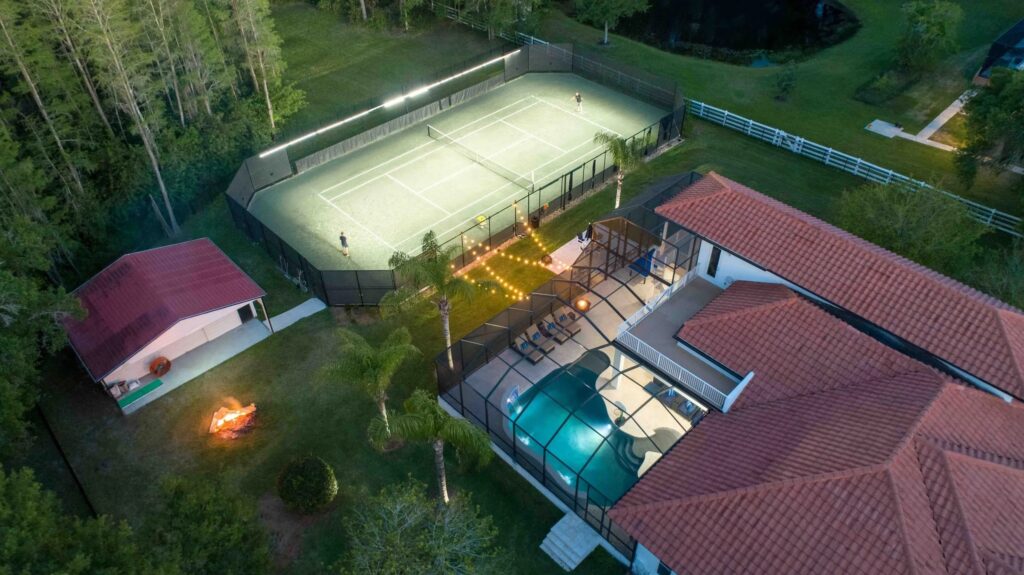
“It’s not taking an existing fixture that’s used for something else and reapplying it for tennis,” Dettor explained. “These guys spent the time and energy to design something specific for tennis. When you’re dealing with tennis courts, you have a certain amount of light that’s required; you can’t just take something from Home Depot or Lowes as a spotlight and put it on. These guys did a really good job with thinking through all the details of the game of tennis, and designing a product that can work within all the other logistics.”
The result is a lighting system that addresses challenges extending well beyond illumination alone. For private homeowners, aesthetics can be just as important as performance. Tweener’s lower-profile system provides an alternative that can complement residential settings while still delivering the light needed for evening play. Todd Dotter, who installed one of the earliest residential systems, noted that neighborhood height restrictions made conventional lighting impractical, while Tweener offered a solution that fit both the property and the game.
“One of the great things about Tweener is how quickly it can be installed, and how instantly you can transform unusable courts to usable ones,” Dettor said. “We have seen them used in underserved communities where you have banks of courts, and with the efficiency of the lights the municipalities are seeing the value of it and the return on their investment.”
That same flexibility is attracting attention beyond residential installations. As more clubs and public facilities look for practical ways to extend court availability without dramatically altering the appearance of their venues, purpose-built lighting systems are becoming an increasingly attractive option. Rather than forcing facilities to choose between functionality and aesthetics, innovative designs like Tweener demonstrate that the two can work together.
For parks departments, tennis clubs and private facilities, every tennis court represents a significant investment. Yet across the country, many courts remain underutilized once the sun goes down, not because players don’t want to play, but because daylight simply runs out.
Dettor believes that’s where purpose-built lighting can make the greatest impact.
“We’re not just selling lights, we’re helping facilities get more use out of the courts they’ve already invested in,” he explained, noting that extending playing hours creates opportunities for league play, instructional programs, tournaments and recreational tennis without the expense of building additional courts.
As tennis participation continues to grow, many communities face a common challenge: demand for court time often exceeds availability, particularly during the evening hours when most recreational players are available. While constructing new facilities may not always be financially feasible, improving the usability of existing courts can provide an immediate and cost-effective solution.
That philosophy has become one of the driving forces behind 10-S Tennis Supply’s introduction of Tweener to the U.S. market.
The company is already seeing that concept translate into real-world projects. Municipal installations are underway in states including Indiana, Oklahoma, South Carolina and North Carolina, where communities are looking for practical ways to expand recreational opportunities without dramatically increasing infrastructure costs. With Tweener, these projects are becoming an accessible option for public parks and community tennis facilities seeking to serve more players throughout the day.
Dettor said one of the most rewarding aspects of introducing the system has been watching facility managers recognize that lighting should not simply be viewed as an expense, but as an investment in maximizing court usage. Every additional hour of available court time creates new opportunities for junior programs, adult leagues, lessons, and recreational play. And for an increasing number of clubs and municipalities, innovative lighting is becoming an important part of the answer.


For Dettor and the team at 10-S Tennis Supply, Tweener represents a practical solution to a challenge faced by clubs, municipalities and homeowners alike: how to create more opportunities to play without dramatically increasing costs or expanding existing facilities.
“There are thousands of tennis courts being underutilized because it is a big investment by municipalities to undergo, but Tweener really helps eliminate that issue,” Dettor concluded.
Tennis continues to enjoy renewed popularity across the country, innovative infrastructure will play an increasingly important role in supporting that growth. Growing the game doesn’t always require building another court. Sometimes, it simply means keeping the lights on.