Centercourt’s Focus on Education Helps Coaches and Players
World-famous tennis coach Simon Wheatley visits Centercourt to work with coaches, players and parents
The goal of any tennis coach is to maximize the experience of their students and players, and help their clientele develop the proper skills that will help them develop. That requires a commitment to teaching but also the ability to adapt and evolve as coaches and not be opposed to learning new ways to do so.
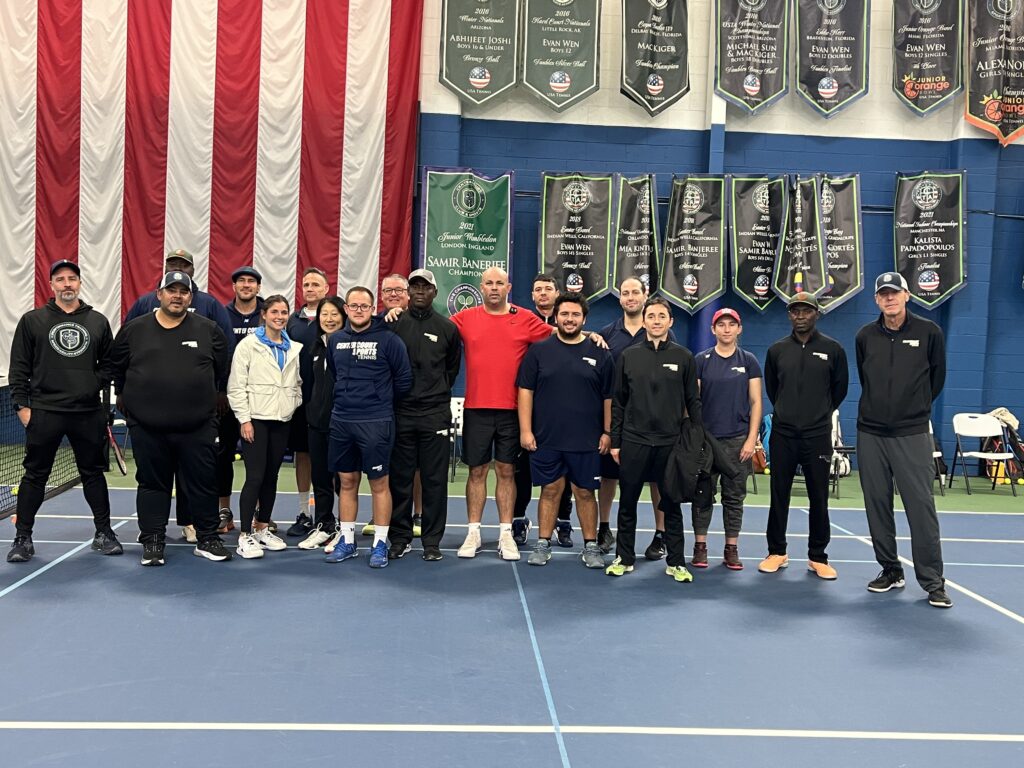
With that in mind, the Centercourt Performance Tennis Academy relishes the role of having their team of coaches learn from not only each other, but also experts coming in from the outside. This past fall, the academy brought in one of the world’s foremost experts in tennis consulting, Simon Wheatley, who has a long track record of developing both players and coaches.
“I think it’s a great thing that under Conrad’s leadership, Centercourt embraces the idea of bringing in external consultants, and having his team learn from people who go around the world helping academies, federations, players, parents, etc.” said Wheatley. “By doing so you can gain insights from around the world and share the best practices. If you can increase the performance of his team, then the players will get better, the members will be happy and the parents will feel more fulfilled.”
That leadership comes from Centercourt Tennis Academy CEO Conrad Singh, who came to Centercourt with his own rich background in tennis coaching and development in many stops around the world, including Australia, China, Japan, Spain and more. That international approach and collaboration is an integral part of Singh’s approach at Centercourt, and is demonstrated in his desire to have his team always learning from the best.
“My question is always, ‘who is coaching the coaches?’ and ‘who is mentoring the leaders?’, explains Singh. “Of course, we do this extremely well internally. However, to have a global leader like Simon Wheatley come to our facilities and spent multiple hours with the coaches is invaluable.”
That is the ultimate goal, after all, to always be improving as coaches and making sure the drills and lessons being taught to players, of all levels, are better than the ones done in the past.
Wheatley brought his extensive background to the Centercourt team. Since 2007, he has served as the Coach Education Manager for the Lawn Tennis Association, the governing body of tennis in Great Britain, the author of two best-selling coaching books, and has trained more than 10,000 coaches throughout 40 different countries.
His visit to Centercourt consisted of multiple facets, beginning with demonstrating a variety of drills that can be used to truly maximize the time on court, and get the most out of every single lesson, as opposed to trying to extract as many lessons as you can out of a player or member. Some of those drills included three-to-one serving drills, with three servers on the baseline and one returner, and from that you run through a number of different things. This creates a lesson where the players are constantly moving, and allows you to take a lot of serves in the drill.
“I really focused a lot on poaching skills for doubles and net play for singles,” Wheatley explained. “Then I moved more into the return of serve and serve drills to show how you can create a lot of high-volume and high-repetition exercises.”
That was at the heart of Wheatley’s demonstration to the coaches during the early stages of the day: creating lessons where players hit lots of balls. That may sound simple and obvious, but oftentimes, there is too much time spent on ball collection and chasing during lessons.
Wheatley then worked with Centercourt’s full-time academy players both on and off the court, with the emphasis on explaining to them the standards and work ethic required of players around the world, and how they can reach their potential within tennis.
“What’s been really great is seeing the coaches taking notes and filming the drills while I show them,” said Wheatley. “It demonstrates that they are really open to outside people coming in and learning from them. I’m a stranger to most of these people, but as coaches, it’s important that we can all learn from each other and improve. Centercourt has created a great environment to learn under, and I do look forward to coming back because of that reason.”
Rounding out the day was a seminar with parents of the academy’s players, where Wheatley spoke about different global pathways that exist as well how juniors can reach their potential while fielding questions from the parents.
Centercourt takes great pride in its ability to best prepare its coaches in-house, but they are not afraid to bring in experts like Wheatley to add to that, which illustrates its dedication to the players and club members that it serves.
“The injection of energy, passion and the reinvigoration of our teams ideas keeps everyone fresh,” said Singh. “We have seen that each time we bring in an outside expert, our coaches begin to exchange more ideas and are working very well together on court. They become more creative by seeing how many ideas the top experienced educators possess.”
That culture stems from Centercourt’s Managing Partner Clay Bibbee, who Singh says has the foresight and desire to bring in the world’s leading educators to further the education of its coaches, which in turn trickles down to the players.
“What I would ask of these players is that they go out and play around with the drills we went over, and see what works best for them. Nothing is better than trial-and-error,” said Wheatley. “Some of the coaches work in the mini-tennis space, some in high performance, and some in the adult market space, so it varies. But if they can play around with these ideas, and mold and adapt them for their own players to see if it increases the enjoyment of their players tennis experiences, that, at the end of the day, is the ultimate goal.”
Coaching is an ever-changing art form, and it’s important that coaches and instructors in our industry are always willing to grow and improve. Centercourt has embraced that notion and integrated it into the education of its coaches and directors.
“Our culture at Centercourt embraces the fact that education is a lifelong pursuit,” said Singh. “ And we encourage all of our team members to be the same.”