Green Ball Tactical Fundamentals
This is a continuation to the articles about tactics in Red Ball and Orange Ball stages. Previously we talked about Red Ball being the stage to understand tennis is a game of errors; the less errors we do, the more successful we are. In Orange Ball, we carried on the previous ideas and added the concept of “open space” and the net as probably the most important tactical ideas of the stage; to develop net skills is fundamental before transitioning to a full court where players would probably be undersized.
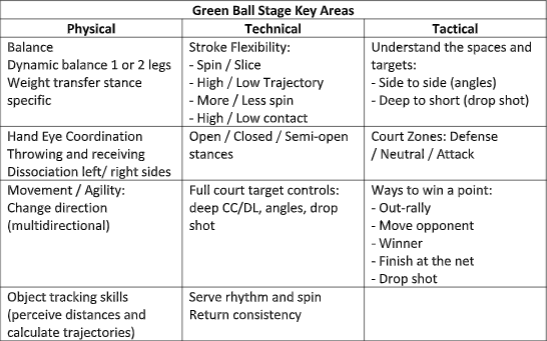
The transition to Green Ball brings the obvious full-court size with the low compression balls; the key tactical element in this stage would be to master the usage of the spaces both from side to side and deep to short. It is also important at this stage to get a basic understanding about court position and how it is connected to the tactics.
Check on the following table a general overview of this Stage and the needs in the different development areas:
- Winning by being more consistent than the opponent (Out-rally):
How does this concept evolve from Orange to Green? Since the court size is considerably larger, stroke flexibility is a key to avoid errors at this stage (different heights and use of the slice). To understand court positions is also a key to develop a smart shot selection; knowing when they have to play with more margin and when they can be more aggressive is key to percentages.
Here’s a game to develop the understanding of court position (and shot selection):
Points where the players must call their own court position every ball they hit (Defense/Neutral/Attack), points from attack position count double. With this rule we are encouraging to be consistent and take the time to build up the point until attacking opportunities emerge (we must develop the court position understanding through a progression from feeding before we can play this type of games). It is also important to understand when my opponent is in “defense” I should probably expect a shorter ball I can attack, therefore I have to anticipate that and position myself close to de baseline or even inside the baseline to be able to get to the shorter ball.
- Winning by using the width of the court (move your opponent):
This is a key area in this stage. Players are in many occasions undersized for the courts and moving your opponent is a very successful tactic in this stage. There is a main difference between Orange and Green; in Orange we discussed the key point was to control the change of directions and focus generally on the development of the “empty space” concept. In Green Ball we should start to develop the specific targets for that, I’m mainly talking about the “angles”. Here comes again the stroke flexibility, can your player open the court with a short top-spin angle (the bounce cuts through the singles sideline and not through the baseline)? Please make sure you develop your players technically and provide them with all the tools to play the game.
Here’s a game to develop the use of angles:
I like to set three flat cones on the singles sideline between the baseline and the service line. The coach feeds the ball to the “challenger” who has to attempt to hit an angle through the cones (I typically give them a 2nd attempt if they miss to encourage the experimentation and skill acquisition). The champion can only return crosscourt. If the angle was successful, the challenger will have a huge open space to attack; let them finish the point freely.
- Winning using the depth of the court (from deep to short, dropshot):
To control the space from deep to short is also a key area of development in Green Ball. Slices are a must in Green Ball, not only to be able to defend the space and use them to avoid mistakes, but also to use as a drop shot.
Here’s a game to develop the drop shot:
Set a marker one step behind the corner baseline/singles line. The defender has to start the point touching the marker with one foot. Coach feeds a ball to the attacking player who drop shots. The defender can start running once the coaches feed has bounced on the court. The point is played freely from here.
- Winning by finishing at the net:
Even though it is usually not a successful tactic on the first stages of Green Ball, we have to keep developing net skills. I have a few recommendations for that:
→Use half court games where the spaces for passing shots are limited and therefore it is easier to cover the net.
→Big focus on the approach shot and how it is crucial in order to obtain an easier volley.
→When setting a full court game with the goal of finish at the net, set rules that encourage the first shot to be hit to the net player.
→Allow plenty of technical development of the net play from feeding at this stage. Players will tend not to go to the net just with open games because of the low success rate.
In conclusion, to control the space (angles, drop shots, etc.) and to understand your court position (and the opponent’s one) are probably the tactical ideas I consider to be most fundamental in the Green Ball stage. It’s important to always remember that the reason why we use low compression balls in the first place is to develop a tactical mind.