
If the Shoe Fits
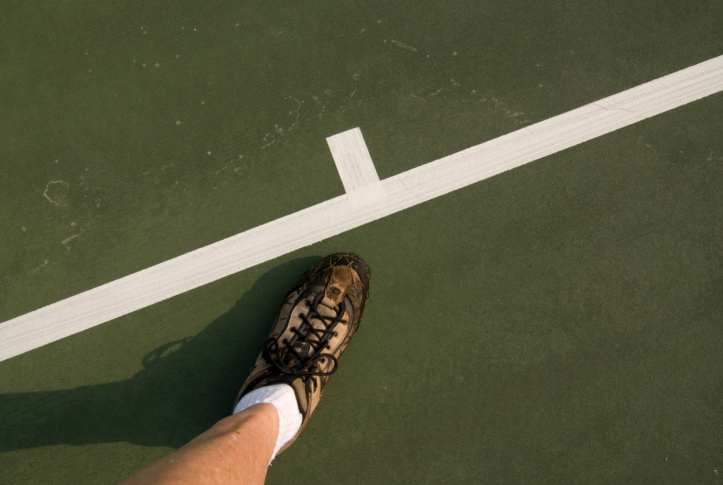
Do you need new tennis shoes? Maybe you are reluctant to make that purchase because of past bad experiences getting shoes that did not fit well. Maybe your shoes are so comfortable that you are willing to live with them even if they are no longer supportive or cushioned.
A few guidelines may help save you from wasted purchases. I would love to have back the hundreds of dollars that I lost on poor shoe selection. (Hundreds is a conservative estimate).
In a recent public service presentation at the Hospital for Special Surgery, Scott Ellis, MD, discussed how we can best care for our feet. The average woman’s feet carry her 70,000 miles in a lifetime and absorb 10,000 tons of force every day. He cited a study of women’s shoe use that indicates 88 percent of respondents complained of foot pain, with 76 percent of them showing forefoot deformities (bunions, and hammertoes). So it was not surprising to learn that 75 percent of the survey participants had not had their feet measured in five years.
We have options today to help us get that elusive “great fit.” If you shop in a warehouse type store with no sales help, try downloading a printable foot-sizing chart from shoes.com. This chart is accurate and somewhat helpful in determining how your foot length compares to standard sizes.
Shoe shape is often more important than length. My experience has been that there are two basic shapes to the bottom of tennis shoes: the exclamation point and the parenthesis. If the bottom of the shoes you are considering look like this ( ), compare them to the shoe you are wearing. If they look similar, and you like your shoes, just focus on the length. But if the shoe looks like this ! ! and your current shoe is curved ( ) that shoe will probably not fit well. Shoe shopping is difficult for me because my feet look like ! /.
If you shop online, the options improve. In addition to using the limited foot- sizing chart you might access Shoefitr.com. This program takes internal measurements of internal sizes of shoes to form 2D blueprints of a shoe’s length and footprint, plus a 3D graphic of the shoe’s entire internal dimensions. Shoefitr can then compare these measurements with any other shoe in their database. I entered my current shoe, a size 13 HEAD model, which is wide with lots of room in the arch, and asked the system to compare it to a new Wilson shoe. Shoefitr recommended that I switch to a size 14. When I tried on the Wilson in a store I agreed that the switch was necessary, since the extra length compensated for the room I need for my high arch. At the recent New York Tennis Expo, I spoke with a representative from Holabird Sports who told me that using Shoefitr has improved customer satisfaction by cutting down on the number of returns.
Sporting goods store salesmen know their merchandise, but their knowledge of feet and fit can be sketchy. An upgrade would be to speak with a pedorthist about selecting the right shoe. Pedorthics is an allied health profession that trains people to fit shoes to feet. Dr. Ellis has a pedorthic service affiliated with his practice.
A more accessible option would be to shop at a store with a staff of certified pedorthists.
I spoke with Robert S. Schwartz, a certified pedorthist and CEO of Eneslow Pedorthic Enterprises. His guideline for the proper fitting of shoes is to leave between ¼” and 3/8” room for the longest toe so the foot can elongate in the shoe without banging against the front of the shoe. His staff uses a Brannock device and the iStep foot mapping technology to measure feet. They will evaluate your current shoes for wear patterns and appropriateness for foot type. He finds that tennis players require extra support to help manage the demands of forward, backward, and side-to-side motion. None of us are strangers to the Brannock device. We have probably been measured by one of these familiar metal gadgets many times.
No discussion of performance footwear would be complete without examining the pairing of shoes with socks. Do you get blisters or hot spots? You might try wearing a pair of very thin socks as an under layer before putting on your regular cushioned socks. Back when the Jack Purcell was the definitive performance shoe, I developed very badly cracked and calloused heels when I wore them. The problem was solved when I wore silk socks under Woolrich athletic socks.
We are blessed today with socks offering to keep our feet dry and to help cushion the shock of frequent stops and starts. If you are not a compulsive reader this next tip more than likely passed you by. I was stuck on a NYC subway without a newspaper or book, and in desperation I reached into the bag that contained my newly purchased Thorlo Socks. In very small type were their instructions to turn the socks inside out before washing and drying them. This simple procedure restored the socks’ original cushioning and fluffiness. I now wash all of my socks this way.