Mommy and Me Tennis
I was asked this past spring by the parents of some of my five-year-old students if I would consider starting a class for two-, three- and four-year-olds. The younger children had been coming to my club as tagalongs to their siblings’ lessons and were feeling left out. Secure in my belief that Google would rescue me, I enthusiastically said yes. Knowing that Mommy and Me programs are very popular, I was dismayed to get just three hits from my search. And those hits were for programs that had been discontinued.
Since I am teaching mostly 10 & Under Tennis classes, I decided to modify what I do for the needs of younger children.
I began by determining how strict I was going to be with the requirements for joining this experimental program. First, the mothers had to be club members. Outsiders might balk at my club’s rule about all-white clothing in the summer. Then, the children had to have an older sibling in another program I teach. I expected the mothers to be players themselves. And, finally, the mother had to come and participate with her child. I had to turn down one applicant because her busy work schedule would have required her to send her nanny with the child.
I spend every summer day setting up four QuickStart courts in the historic stadium of the West Side Tennis Club so I have plenty of room. For Mommy and Me, I set up a court parallel to these four so I can easily incorporate this group into my summer camp program. The young children feel they are part of the action with the big guys, and, since all the classes break for a fruit snack at the same time, they feel even more included.
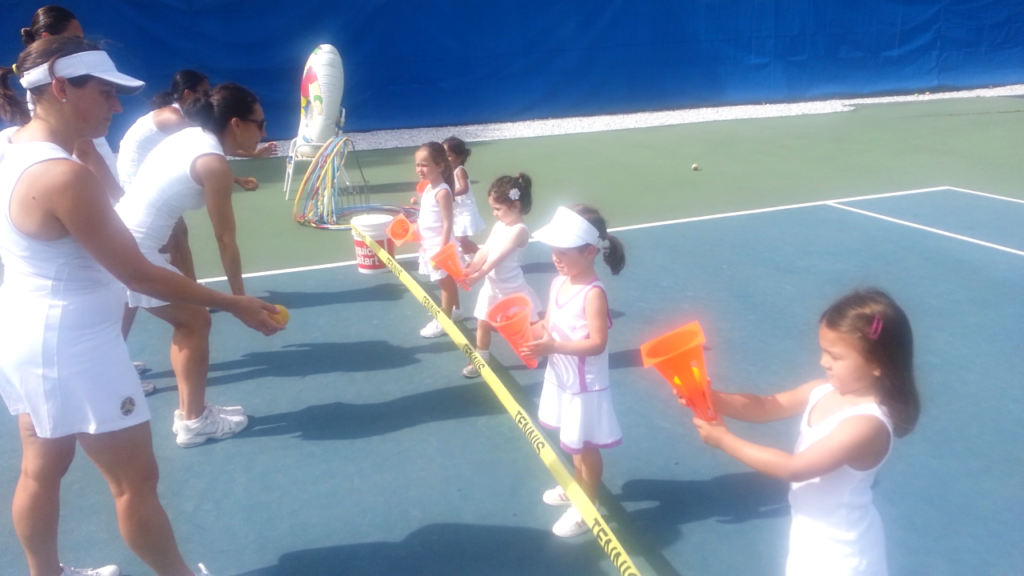
Setting up a court is easy. For net posts, I use the large white and red tubs that are shipped full of 36-foot court balls. I attach a length of yellow tennis/caution tape between the tubs as the net, and I throw down 12-inch yellow rubber strips to set the boundaries of the court.
 You have probably seen the class on television where children use an inverted cone to catch balls. For younger children, I use balls that are extra soft, with no bounce. This increases the success my students have in keeping the balls in the cones (a folded set of socks also works). I then progress to using rackets to catch floppy toys, having the children just hold their rackets in front of them like frying pans to catch the floppy toys on the strings. These methods reduce the risks of failure while the children learn the principles of tracking and receiving.
Then it is time for Italian lessons. I tell them that Bocce is the Italian word for bowling, and for kisses. Using throw down lines, I set up two targets at different distances from the children (maybe three-feet and eight-feet) and have them try to bowl a ball as close to the line as possible. They don’t know that they are also getting a lesson in depth perception, a concept not easily grasped by children.
Next step is tennis horseshoes, using a few hula-hoops and some spare ball hoppers. Para-communication is critical when teaching young children. Show them, don’t tell them. I place one hoop on the hopper so they see what the goal is. I then show them how to hold the hoop (palms up) and how to turn their bodies sideways to get power on the toss. Positioning the children and their mothers about five-feet from the hopper, I have them try to toss the hula-hoops over the hoppers.
 One of my favorite exercises for helping young children learn how to move their bodies is to let them practice transitioning from large motor movements into smaller and more precise actions. I set a ball down on a spare racket, about five-feet from the net and use an inflatable tennis player balloon that is larger than my children. This can be lots of fun. You can also modify a hopper or shopping cart, with a racket stuck up in front as a target.
The children run full speed to the ball on the racket, stop, pick up the ball, and then throw it at the target. I remind them that throwing successfully demands that the opposite foot be put forward, and the throw should start behind the ear.
I limit the Mommy and Me lessons to just 30 minutes. No one gets too tired, and no one gets bored. Everyone in the program wants to come back in the autumn and winter, so I am going to judge this experiment was a success.