My Memories of the U.S. Open
Before the U.S. Open, the pro tennis tour was like a small traveling circus or carnival, where the performers brought their mystery and magic to town for two weeks, then folded up their tents and disappeared for a year. Tennis tournaments were created for and attended by only serious tennis aficionados.
Today, if you have hit more than five tennis balls in your life, you are on someone’s list and are being e-mailed daily that the U.S. Open is once again coming to Flushing Meadows, N.Y. in August.
I have been heeding those reminders since the 1960s—as a spectator, a retail clerk selling hats and shirts, as an usher, and as a representative for a tennis/sports organization.
Being new to the world of tennis during the early days of the U.S. Open, I tried to blend into the crowd by wearing seersucker jackets, unstarched khakis and Weejun loafers. Along with this outfit, I practiced rolling the words United States Lawn Tennis Association across my tongue and teeth. The word “lawn” was removed from the name of the official tennis organization when grass was no longer the surface at the U.S. Open. In a time often defined by “correctness,” I was trying to crack the lingo and learn the code.
I had expensive box seat tickets for the 1974 final, won by Jimmy Connors over Ken Rosewall. I chose instead to take advantage of a friends’ offer to watch the match on the television in the men’s locker room. So I sat there next to Yugoslavian player Zelko Franulovic (currently the tournament director for the Monte Carlo Open) surrounded by the best players in the world. After a careless comment by the television announcer, “Connors has powerful groundstrokes, especially the backhand and forehand,” 1960 U.S. Champion Neale Fraser piped up saying, “My God … what else is there?”
In 1975 at Forest Hills, I sat with a date in one of the premiere boxes during an early round match. A volunteer had offered me seats supposedly with the owner’s permission. I do not remember who was playing, only that I had great seats. Was it a bad match, or had I had enjoyed one too many 24-ounce cans of Foster’s Lager? At that time, the vibe was that Foster’s beer was the Australian players’ predecessor to Gatorade.
When the Open was at Forest Hills, some of the practice courts were hidden from the public. Walking home one day, I noticed a crack in the windscreen on one of these courts. Peeking in, I saw Pancho Segura teaching one of the young American women players. What a treat to watch this master motivate his student—he constantly repeated the phrase “If you want to be champion.” He then focused on small points of improvement by setting up a match situation and telling her where she must hit the shot if she wanted to be a winner.
Times were changing and the Open was readying itself for the move to Flushing Meadows. I realized this very clearly one day as I watched Ilie Nastase in Forest Hills raise both middle fingers above his head and explain to the watchful crowd that this was not an insult, but the Romanian peace sign. The seersucker world was indeed crumbling.
With the move to Flushing, I changed from being just a spectator into being a more active participant in the two-week event.
During the 1980s, I belonged to a group that played every week in the indoor courts of the National Tennis Center. As a reward for purchasing seasonal time, players were given free tickets to one of the evening matches. I wound up with tickets to a Stefan Edberg vs. Aaron Krickstein match on a Monday night. In nearly arctic weather, we watched a game that more resembled Pac-Man run amok than it did tennis. The winds were so powerful that debris was constantly blowing across the court. Watching the 2012 final won by Andy Murray reminded me of this match.
Flushing offered much more room to grow, and it may have been the best alternative space to build the site for the Open. But the tricky winds have often tarnished the quality of the tennis. Kickers in the NFL had to learn to adjust their skills when they played the Jets in Shea Stadium right across from the National Tennis Center and the same can be said for those playing at the NTC. In fact, I played in one regional tournament in Flushing where I watched a cross-court lob turn into a down-the-line shot because of the quickly changing winds.
The following year, I played a late afternoon match that caught me on court as twilight descended. I began rushing to finish before dark when suddenly (like a religious conversion) there was light. No one had told me that the lights at the NTC turned on automatically. I slowed down, still lost the match, but understood why many top pros prefer to play at night. The artificial lighting eliminates glare and produces no shadows.
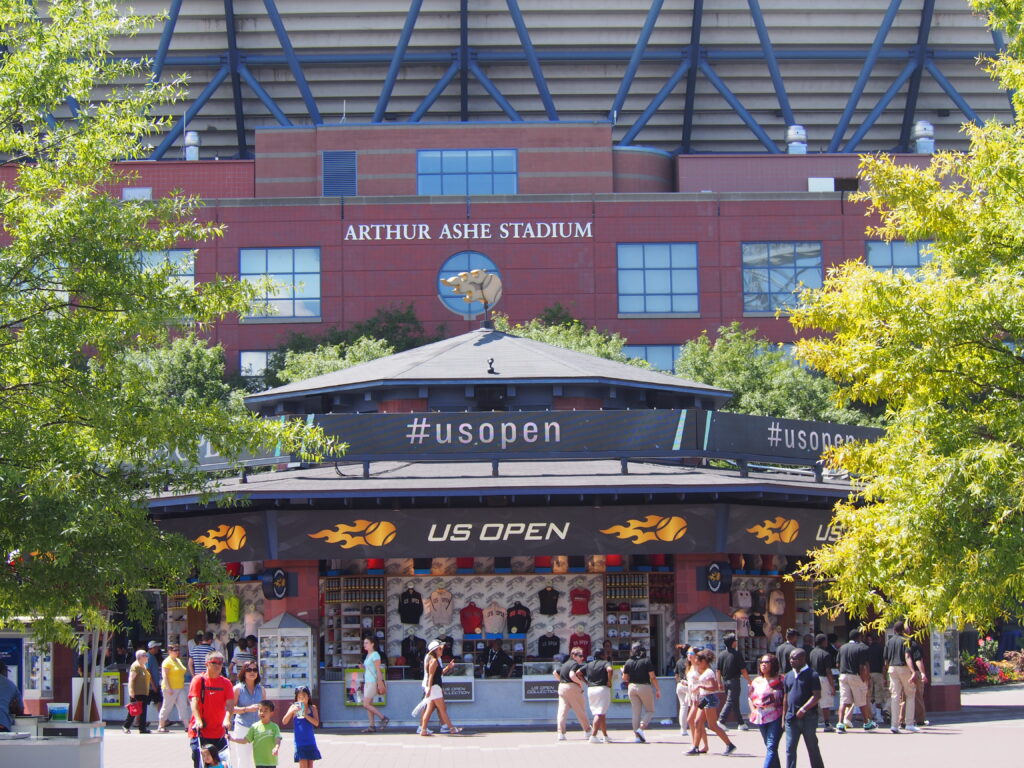
Today, you must be a union member if you want to be an usher at the U.S. Open. But in 2008, non-union part-timers were welcomed. I was an usher that year and worked many hours because the Mets were playing home games at the same time of the U.S. Open, so extra ushers were needed. I learned that people were very creative when explaining why they should not have to sit in the seats they paid for. And I also learned how to be polite but firm when asking people who paid big bucks to wait for a changeover before taking their seats. The next time you watch a match on television, notice how free from stragglers the circular walkways are in Arthur Ashe Stadium. That’s because the ushers are in the portals keeping spectators behind ropes until the changeover. My worst memory was of the belligerent fan who threatened to bull past me if I did not make the two young men standing in front of the rope get back with everyone else who was waiting. He reluctantly shut up only when I explained that there had been a threat against one of the players, and that they were undercover police officers watching the crowds, not the match.
Watching televised matches from different countries shows how quickly poor behavior by latecomers can ruin the game for players and other spectators. The ushers at the U.S. Open perform at a very high level in keeping the crowds moving smoothly. It is often a thankless job.
The law of supply and demand rules the retail experience at Flushing Meadows. During the first week, clerks are busy with customers making multiple purchases. By week two, the sales clerks spend a lot of time apologizing because they are out of the most popular sizes and items. Not every customer goes home a winner.
U.S. Open fans are aggressive hunters for memorabilia. One year, I volunteered to sit at the table of a successful New York City sports organization. The organization offers multiple sports programs for juniors and seniors at parks in every borough of New York. The table had only photocopies of the organizations flyers. Almost no one stopped to talk to me.
People attending the Open are very busy stuffing their bags with rubber bracelets, sound dampeners, cheap commemorative coins and other giveaway items.
So the big lesson for anyone doing outreach at the U.S. Open is … no goodies, no visitors. And in the spirit of full disclosure, I have a bag of goodies stuffed in the corner of a closet, which I promise to trash someday.
I miss the old days when, during the final hours of a tournament, players said their goodbyes and began drifting toward their next event. The end of the tournament evoked poignant feelings, like the sadness that comes with the end of a summer vacation or romance.
Today, “next” is the operative word. If you turn on the TV, there is always a match being broadcast from somewhere. Travel is more demanding on the players. Today, there seems to be perpetual post-match commentaries and replays that the tournament never seems to end.
So, final goodbyes to lawn tennis, final goodbyes to seersucker, and welcome to the global reach of tennis today.