Orange Ball Workshop
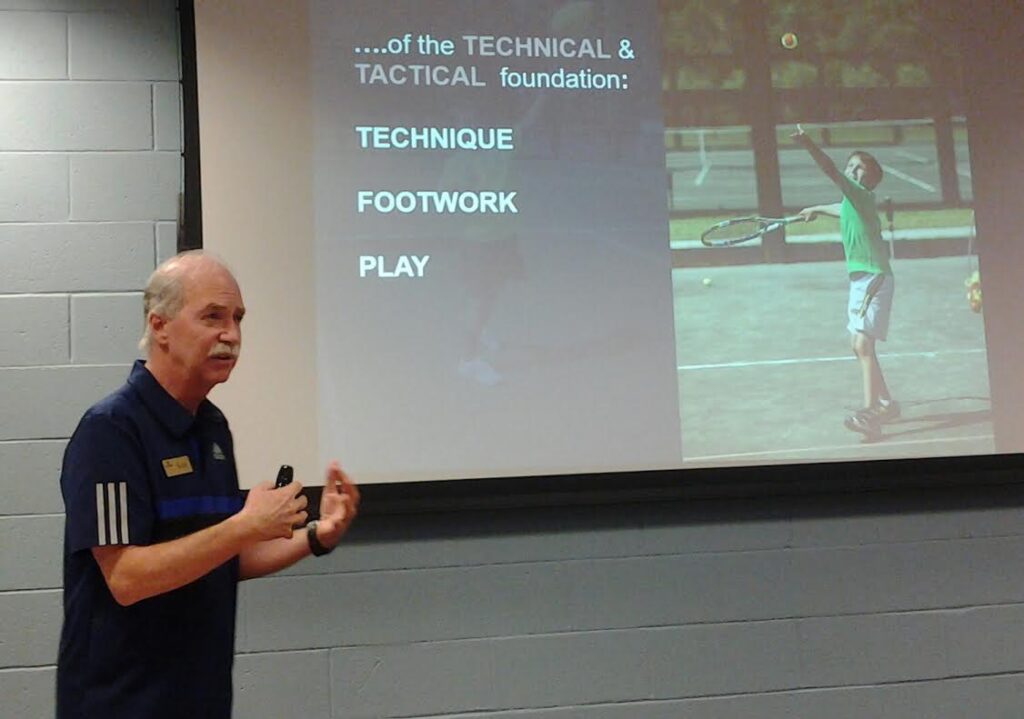
Even a massive traffic tie up on the highway near La Guardia Airport couldn’t stop 40 determined tennis trainers from attending a recent orange ball workshop, the USTA Player Development Team USA Early Development Camp Coach Training, at the USTA Billie Jean King National Tennis Center. The program’s facilitators were Kirk Anderson, the USTA director of coaching education; and Jeff Rothstein, USTA Early Development Camp faculty lead coach.
According to USTA Eastern Assistant Executive Director Jenny Schnitzer, 15 of the registered participants were PTA pros, 15 were PTR pros, and 10 had completed the online CoachYouth Tennis program. I was surprised to find myself sitting next to Whitney Kraft, director of tennis at the National Tennis Center. He said he registered as a participant in the workshop so he could better understand 10 & Under programs, and develop strong selling points for his meetings with parents. After trading knee surgery stories with USTA Eastern Long Island Region President Dan Burgess, I asked why he was on court rather than just observing the program. He told me he felt it was the best way to stay up-to-date, and easier than reading memos.
The official name of the workshop, the “USTA Player Development Team USA Early Development Camp Coach Training,” is a wordy mouthful, and it reflects the comprehensive, highly-detailed technical program outlined by the USTA.
But the language gets simpler as the fundamentals find their way onto tennis courts. Kirk and Jeff suggested that we learn some new ways and words to describe what we do on tennis courts with students. Instead of calling what we do “lessons,” try instead referring to this time as “practices.” They said not to use the word “drills,” but call them “activities.” In the same way homework becomes a take-home activity, the reason for these language changes is to make the underlying new teaching concepts more user-friendly.
The USTA is heading toward programs that develop athletes first. Even while children are developing their tennis skills, they should not be playing tennis on a daily basis. Rather, they should be playing other sports and balancing their athletic development.
With our new knowledge, we followed Kirk and Jeff onto the courts to put our skills into practice. A neutral observer watching us learn a different method of teaching children to serve may have asked, “What the ‘L’ is going on?” The new technique is to have children hit the serve as if they were throwing a ball. The “L” is the angle made by the upper and lower arm as the student strikes the ball. This new method might be the obituary for phrases like “scratch your back” and “elbow high to the sky.”
There should be an emphasis in classes on teaching children how to throw, and how to run faster. Children who do not play games requiring them to throw often lead with their right foot when they throw right-handed. This can lead to life-long problems while serving and hitting overheads. So, making students better athletes leads to making them better tennis players.
I feared being embarrassed when Kirk gathered us to learn what I would call horizontal four-ball or two-person juggling. I was amazed at how quickly I adapted to this activity. Just this week, I taught this to a group of fifth graders who came to my club on an outreach event. They easily convinced the teachers who have been with them all year to join them as they kept four balls rotating in the air.
A great exercise to develop balance, core strength and coordination is to have students face each other across the doubles alley while assuming a one-handed push-up position or even a yoga plank. Then, have them simply push balls back and forth cooperatively.
Jeff made two critical points about rackets for children. The USTA believes we need better-quality children’s rackets. The USTA recommends that teachers themselves use 25-inch rackets when working with youth programs. I have started doing this, but I am still stuck using a 26-inch frame. I am hoping to move to a 25-incher soon. Using a smaller racket has forced me to concentrate on my take-back, point of contact and follow-through.
The rate at which children should transition from red to orange to green dot balls should be based on earned advancement, rather than just age. The USTA has a great slogan to guide these transitions: “It is not a race to the yellow ball.”
The range of correctness for teaching tennis techniques has been broadened. There should be no one-way or strict catechism for teaching. A teacher or program that is too rigid could drive a student into that 70 percent of youngsters who quit organized sports by the age of 13.
Jeff and Kirk both made a very simple request of all the participants: “Don’t be a child‘s last coach.”
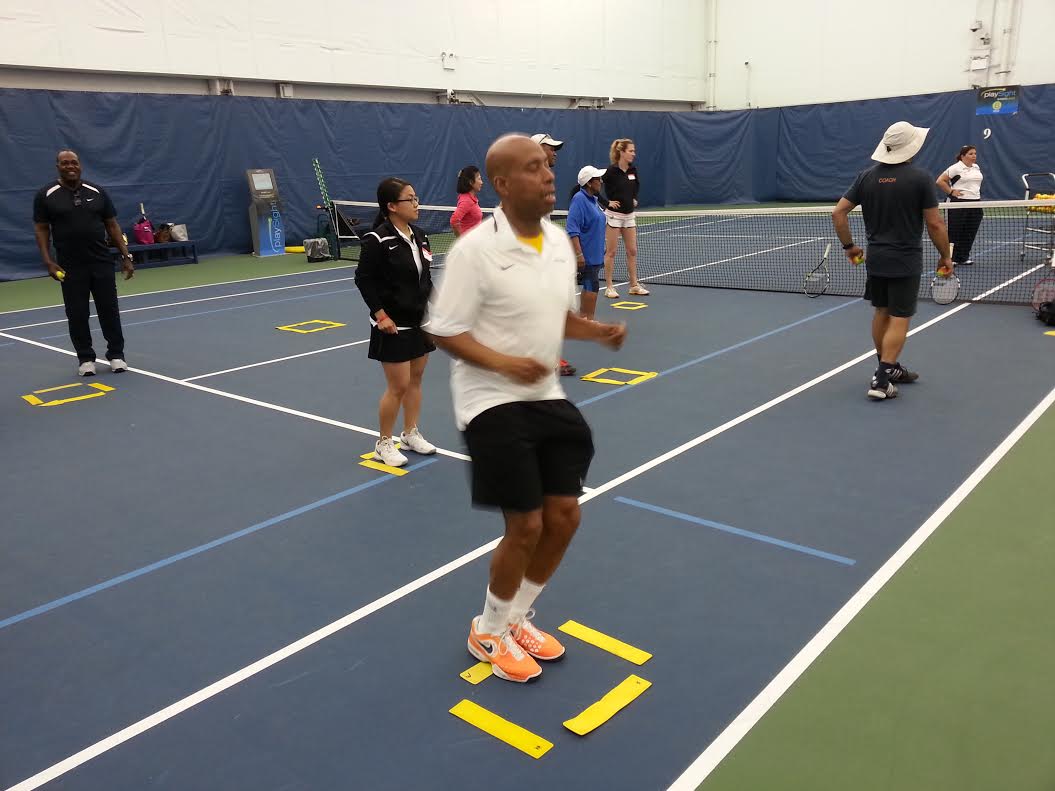
Coaches trying to keep up with the instructors during a footwork drill at the USTA Player Development Team USA Early Development Camp Coach Training workshop
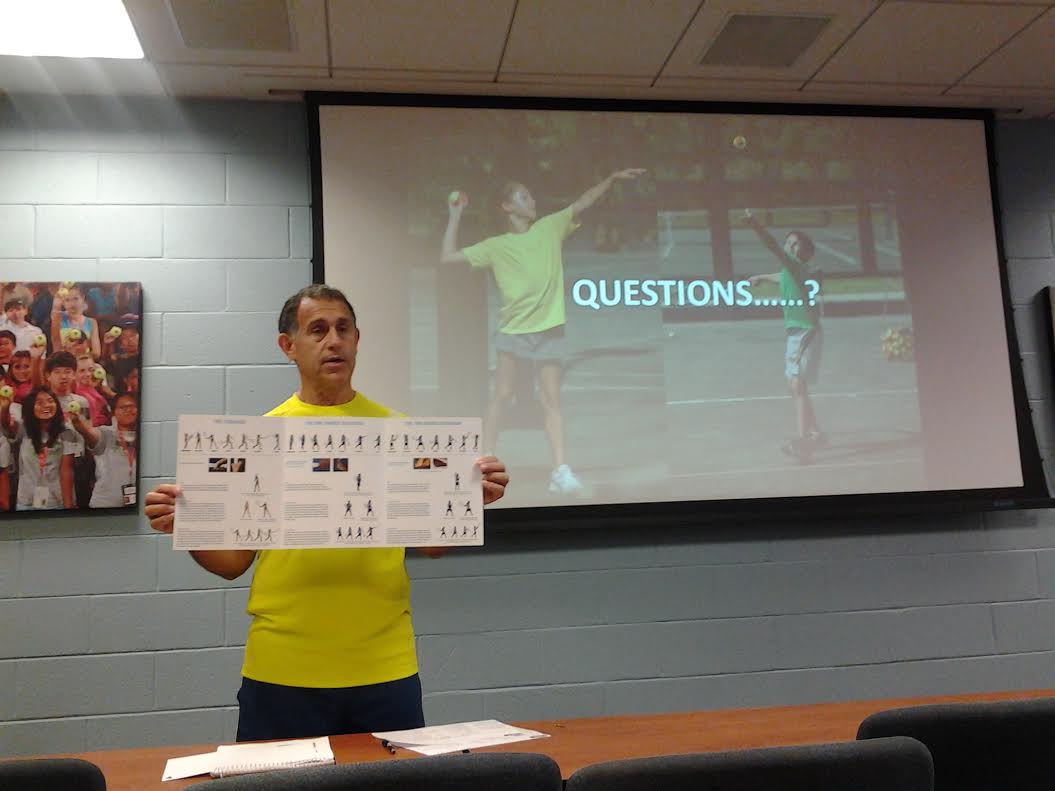
Jeff Rothstein, USTA Eastern board member and executive regional director of junior tennis development and programming for Centercourt, goes over some coaching points
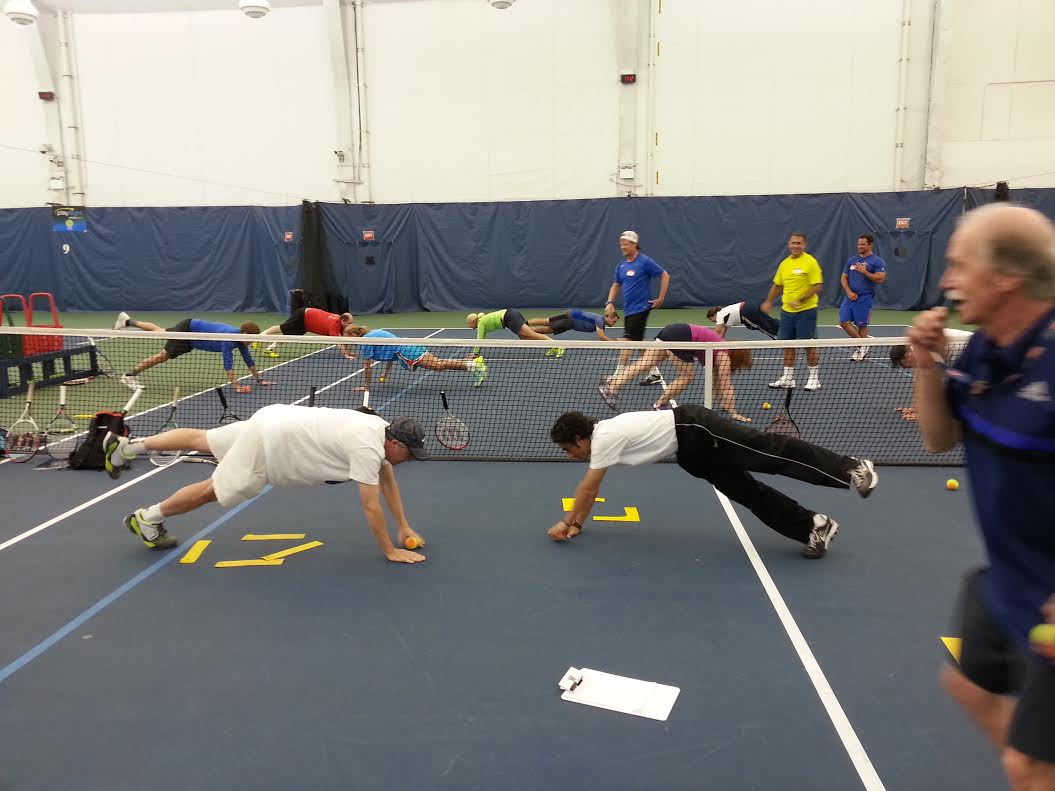
Coaches practice some drills in order to perfect them for their students