Spatial Reasoning—A True Phenomenon … Part I: Traffic Light
Spatial reasoning (SR) is not a new phenomenon. In fact, it is a routine aspect of our daily lives that people use unconsciously and goes unchecked and unused efficiently. Spatial reasoning is used in a few ways. One of the ways it helps is to form a mental map of where things are. Secondly, it is used to construct imaginary pathways in our heads before executing our movements. In this article, I will discuss mental mapping and how one can use it to teach a certain skill. I hope to demonstrate mental mapping via a simple visual cue that I use on a regular basis in order to help my players in one area for the time being: Volleys.
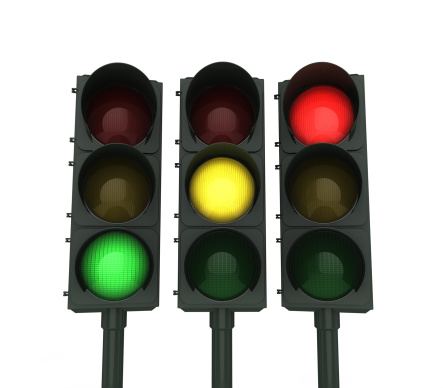
Take your average traffic light. You’ve got your red, yellow and green—all having recognized meanings that we need not elaborate here; unless you live and drive your way around my hometown in Manhattan and the traffic light coupled with clogged roads have unprecedented colorful-language associated with it. Back to our traffic light and volleys … most players have a tendency to be uncomfortable at the net, and one of the reasons behind it is the lack of continental grip, but however, for our purpose, we will assume we have the proper grip and footwork. I now want you to flip the traffic light upside down in your head and the order now changes to green, yellow and red.
With our volleys, our contact point is always in front of us, however, where and what swing length is a point of discussion at times—especially for players learning and or new to the game.
If a player is making the contact above their shoulders, they have a ‘green light’ and can be a bit free to swing at the volleys, perhaps even take a swinging volley—depending on their discretion and control (because if it is a swing volley, then it is a full stroke without the bounce; if it is a volley, then it is a “block”). Now, I hope you have noticed that the player has already created a mental map of where a high volley is and how to execute it. When the player meets a volley between their shoulders and waist, it’s a ‘yellow light’ and again, can use their discretion to make a decent block or light swing at the volley; depending on where the contact is made within that zone. And finally the dreaded low-volley, where the ‘red light’ should ring alarm bells to help the player ‘stop’ the contact and not swing through the contact point.
A general tip to most leisure and intermediate players: Your contact on your volley can and should be your follow-thru. Leave it to the professionals and advanced players to “carve” at the point of contact.
This is a minute aspect “mental mapping.” And it is made possible by a synapse, a structure within our brain that permits a neuron (or nerve cell) to pass an electrical or chemical signal (that carries information) to another cell within the brain and or spinal cord. The more signals that are passed within neurons, the more exercise the brain receives, hence making synapses be a metaphor for roots in a tree: the stronger the roots, the taller the tree can grow—and this is irrefutable information proven by neurospecialists time and again over the years.
As a teacher of this beautiful sport, which also happens to be my religion, I believe in using tips and knowledge from other fields and use it to help my players realize their innate abilities and learn about themselves and excel and enjoy in this sport to their fullest capacity! Spatial reasoning is a vital aspect in my workings—no matter the age or level. Once understood and used well, the benefits are significant!
Now, it’s time for you to head out there and practice! If you need more help, feel free to contact me at your convenience. Enjoy, and play well! Stay tuned for Part II of my series on Spatial Reasoning: A True Phenomenon.