USTA Metro Region Pages: November/December 2023

USTA Eastern Hosts Adaptive Sectional Championships at USTA Billie Jean King National Tennis Center
A little inclement weather couldn’t dampen the spirits of those participating in the 2023 USTA Eastern Adaptive Sectional Championships, held at the USTA Billie Jean King National Tennis Center in Flushing Meadows, N.Y. With players forced to compete on the facility’s indoor courts as the remnants of Tropical Storm Ophelia swirled around the greater New York City area, Tyler Conover and partner Sebastian Wernecke—based out of Commack, N.Y.—claimed the title at the third annual event and will next head down to the USTA National Campus in Orlando, Florida in November to represent the section at the national tournament. The pair will be joined by Lena Franklin and Alexander Dobrin, who finished as section finalists.
“I was really happy,” Conover said of capturing the final point of the championship. “It was nice, and I have come a long way.”
The tournament was contested in a unified doubles format, which means that one player with a disability competes alongside another player without one. Wernecke—a tennis pro who has worked with Conover since 2019 at Sportime Kings Park and at the Old Field Club in Setauket, N.Y.—echoed his partner’s sentiment, noting that his young student’s persistent enthusiasm, focus and determination ultimately carried the team over the line.
“Anyone who knows Tyler knows he has a passion for tennis,” Wernecke said. “Since the first time we set forth on a tennis court together up until now, he has been unwavering in his commitment. His remarkable work ethic has always stood out—he even braved outdoor sessions in the winter, and he has devoted [so much] hard work to earn his spot on the JV team at Commack High School. Over the years, I have seen him develop into the tennis player he is today, and to be able to compete together was really special, never mind taking home the trophy!”
Beyond commitment, Wernecke said that his partner was particularly dialed in on service games. Down 2-3 in the final, Conover hit several strong serves to hold at love and ultimately shift the momentum of the match. It’s one of the facets of his game that Conover continues to improve under Wernecke’s supervision.
“I have been working on my serves and [getting the] toss up higher,” Conover explained.
The high intensity level from Conover and his fellow competitors is always a hallmark of the competition, said Mark McIntyre, the event’s tournament director.
“One of the highlights for me every time is seeing all of the athletes step up under the pressure and compete,” he said. “I work with a lot of the players throughout the year, and I can honestly say they were playing at their best throughout the matches. Some of the tiebreaks had some really amazing points. It was super fun to watch.”
And no doubt fun to play. In 2024, McIntyre hopes to further open up the draw to give more players the opportunity to participate.
“I’d like to be able to include more adaptive athletes and their families,” he said. “I look forward to the day when the USTA Eastern Adaptive Sectional Championships is a weekend affair. We would have two full days competing on the National Tennis Center courts and maybe eventually hold the final matches inside Arthur Ashe Stadium.”
The tournament is one of many initiatives USTA Eastern has organized to help make the sport more inclusive at the local level. In 2022, the section hosted a Wheelchair and Adaptive Tennis Symposium to encourage coaches and tennis facilities to expand their program offerings to include those with disabilities. The organization has also collaborated with the tennis non-profit Love Serving Autism to offer trainings that empower instructors to reach out to this underserved community. Dobrin—a P.E. teacher at the NYC-based Queens Transition Center—attended one of these sessions and ultimately integrated what he learned into his curriculum; months later, he and one of his students finished runners-up at the sectional, an experience neither will soon forget, he said.
And for Conover and Franklin, it offered one more chance to compete and show off their flashy serves and hot shots in a competitive environment.
“I am excited to go play tennis in Florida,” Conover said of his upcoming trip to the National Campus. “I want to win every single point!”
USTA Eastern hosts several adaptive training sessions for coaches throughout the year. Interested in attending? Email David Williams at williams@eastern.usta.com.
Eastern Players Collect Statement Wins at the 2023 U.S. Open
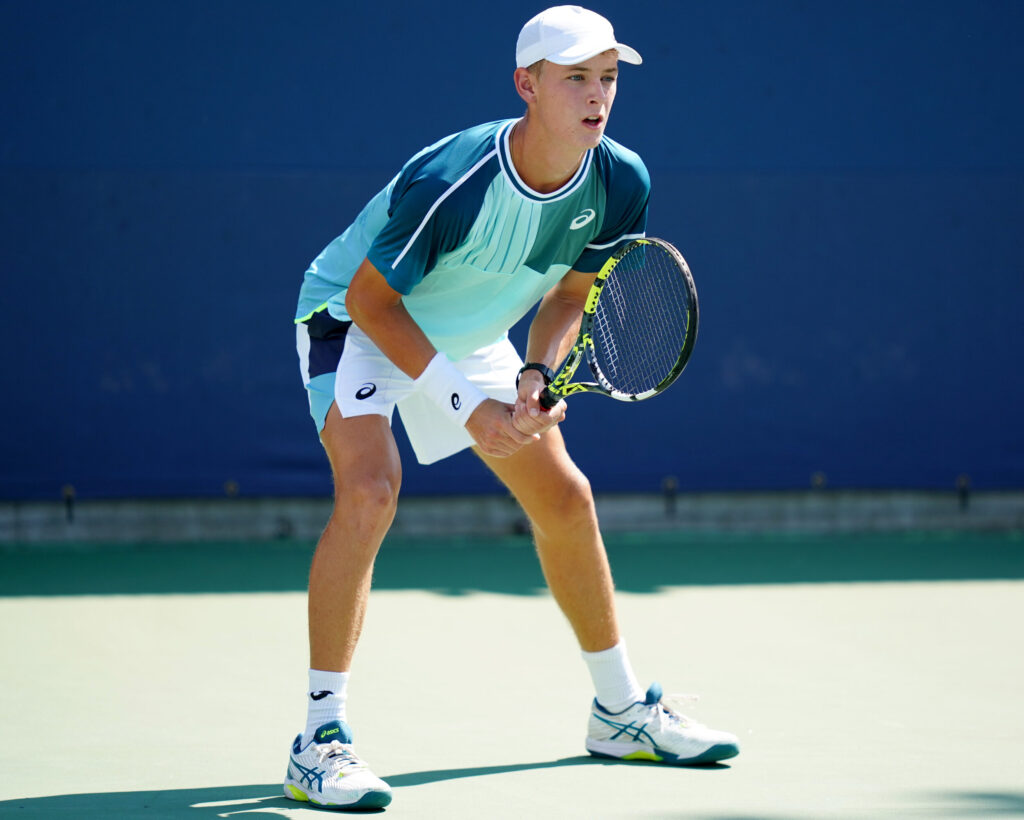
On the rise. In their own backyard, several Eastern juniors turned in strong performances at the 2023 US Open.
Competing in his final junior Grand Slam before heading off to Harvard University this fall, Cooper Williams reached the quarterfinals of both the boys’ singles and doubles events. The results cap off a solid year on the court for the NYC native, who lifted the boys’ doubles trophy at the Australian Open earlier in January (with Learner Tien, of California) and earned a boys’ singles semifinals berth at Wimbledon in July. Williams entered the tournament as the top-ranked American and showed some impressive grit en route to a final eight showing. In the second round, his opponent—Lucky Loser Markus Molder, of Estonia—served for the match, but Williams fought back and eventually leveled the score with a scintillating return winner; soon after he claimed the two-and-a-half-hour bout in a third-set tiebreak, 10-7.
Williams ultimately lost another tight three-set battle in the quarterfinals against Brazil’s Joao Fonseca, who would go on to capture the championship title. Both Williams and Fonseca—as well as boys’ No. 2 seed Rodrigo Pacheco Méndez, of Mexico—competed at USTA Eastern’s Big Apple Cup in 2019, which was held on the same courts at the USTA Billie Jean King National Tennis Center where the US Open is contested.
Elsewhere, Eastern’s Shannon Lam nearly pulled off a major upset in the girls’ singles event. The East Brunswick, N.J. resident—who reached the girls’ 18s singles semifinals of the Easter Bowl earlier this year and came through qualifying to earn a spot in the draw at Flushing Meadows—led No. 10 seed Laura Samsonova by a double break in the final set of their first-round match and served for the victory twice. Samsonova ultimately reeled off five games to advance—and eventually reached the semifinals. But Lam, at just 15 years old, continued to prove she has a bright future ahead of her in the game. In doubles, she and partner Mika Stojsavljevic—of Great Britain—knocked out No. 3 seeds Lucciana Perez Alarcon and Alisa Oktiabreva, then took a set off eventual runner-up team Nanaka Sato and Sara Saito—the only set the pair lost en route to the final.
NewYork-Presbyterian Doctor and Former Tennis Coach Shares Insight on Tennis Elbow
It’s an injury tennis players dread. But what does it actually mean when you’re diagnosed with “tennis elbow”? Dr. William N. Levine, Chief of Orthopedics at NewYork-Presbyterian/Columbia and Chair of the Department of Orthopedic Surgery at Columbia, is uniquely qualified to answer that question. In addition to regularly treating patients for the injury, he has a deep understanding of the sport itself, having previously played competitively and serving as a tennis coach in his early 20s. We spoke with Dr. Levine about what tennis elbow is and the various measures players can take to prevent getting sidelined by it.
You specialize in treating patients with tennis elbow. Can you explain what is going on in the body when a player receives this diagnosis?
LEVINE: Tennis elbow is the colloquial term. The technical term in medicine is called lateral epicondylitis. The lateral condyle is the bump on the side of your elbow, and it is an attachment site for the muscles and tendons that extend from your wrist. When there is repetitive overuse, when that part of the body is seeing too much stress, it leads to some microtearing on the lateral side of the elbow. There are some theories that inflammation is involved. But when you analyze the tissue under a microscope, you don’t see many inflamed cells. So the injury is probably more degenerative than inflammatory. That kind of makes sense, since anti-inflammatory medicines aren’t that successful in eliminating pain caused by tennis elbow.
Are there any preventative measures players can take?
LEVINE: Yes, and they relate to stretching and strengthening of the tendons in the forearm. Also it’s very important to make sure that your racquet is properly sized. Many tennis shops can help you determine just what grip size is right for you. But the most important point is really stretching and strengthening, which is at the heart of any preventative programming to prevent common injuries in tennis.
You know a lot about the sport, and not just because some of your patients are players. Before becoming a surgeon, you were a competitive player in high school and later on, a coach. When did you first begin playing?
LEVINE: I grew up in Fargo, North Dakota, and there was a park about a three-and-a-half mile bike ride from my home. I was roughly 10 or 11 when I first picked up a racquet, and I completely fell in love with the sport. In the summers there were no summer camps so I would just ride my bike down to the park and be on the courts from eight in the morning until six at night. I was living on the tennis court. Then I started to play tournaments, traveling the Midwest circuit, competing against much better players than I was and learning life lessons. I made the varsity team at my high school as a freshman, which was rare. I was also named captain my senior year. That year, our team finished runners-up at the state finals, and I won the state doubles championships.
How did you get into teaching the sport?
LEVINE: I went to Stanford for college where clearly I was not going to be able to continue at a competitive level, though I met the legendary coach Dick Gould and ended up becoming a team manager. Then my junior year, I got a job as a high school tennis coach at [nearby] Los Altos High School. The team hadn’t won a match the year before, and they lost only one match the year that I took over, which was fantastic. To see the success of these young men that I had the opportunity to teach was very gratifying. That was kind of my first foray into teaching and mentorship, which has been very instrumental in my career in orthopedics now.
Clearly tennis has played a major role in your life. What do you love about the game?
LEVINE: It’s not about being the biggest, the strongest, the fastest. There’s so much strategy involved. There’s the whole mental element, which I think appeals to my scientific side as a doctor and surgeon. And it’s a sport you can play for life, which is so appealing. Especially when you’re thinking about health, it can be hard to figure out how to fit exercise into your busy schedule. So, if you can go hit tennis balls for an hour, run all over the court and get the blood flowing, get the endorphins going through your body, there’s something really valuable about that…I can [also] directly tie [who I am as an educator] back to my first days in tennis. I think that if you have an inclination toward teaching, there’s probably nothing more gratifying than being able to see the fruits of your labor, seeing the young kid understand what it means to hit a topspin forehand, or what it means to slice a backhand. When you see that light bulb go on, there’s no amount of money in the world that substitutes for that feeling. It’s really incredible when I think about how much tennis has influenced my passion for teaching and education, and that’s what I’ve spent my life and career doing, mentoring students at Columbia and from around the country.